图片
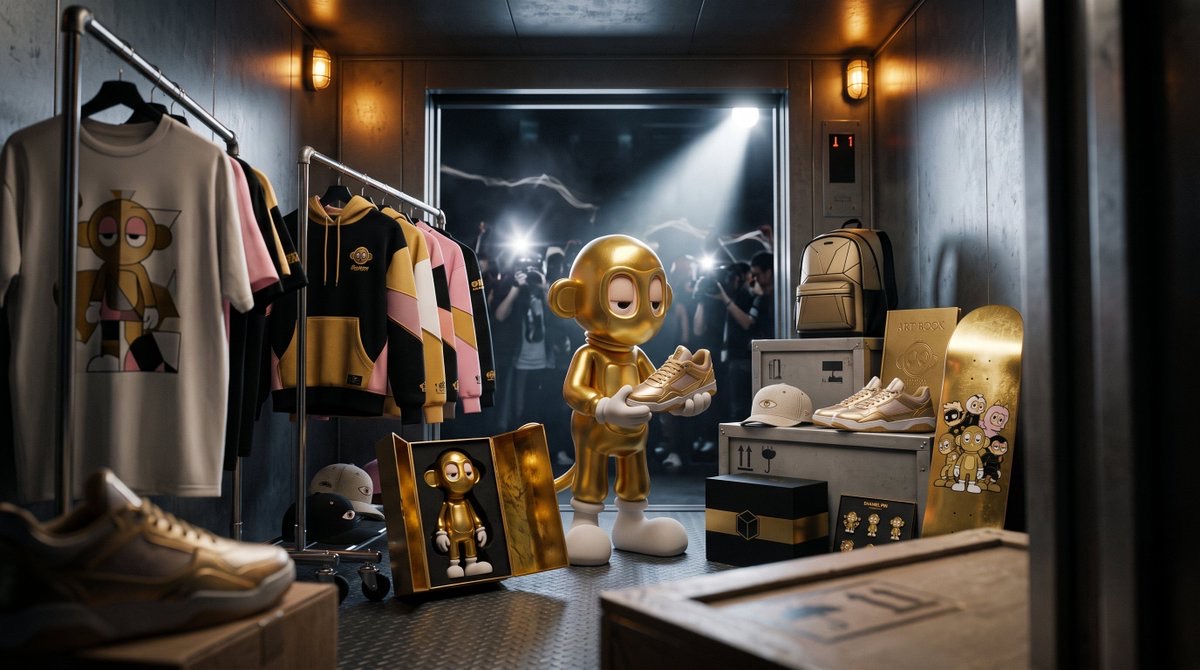
角色宇宙的工业电梯周边发布场景
将上传的角色视觉语言转化为一组统一的服装、玩具与收藏品,并在展览揭幕前的工业货梯中构成电影感产品发布画面。
 Edizkan ⭕🦇@edizkan_
Prompt
创作一个电影感的产品发布场景,展示一整套受上传参考角色启发的周边商品。它们陈列在宽敞的工业货运电梯内,电梯门开启后,通向一间昏暗的展厅。

这套商品必须包含经过精心设计的系列产品:

* 高级连帽衫
* 宽松 T 恤
* 帽子
* 运动鞋
* 背包
* 收藏玩具
* 一套珐琅徽章
* 滑板板面
* 艺术书
* 密封款盲盒

每件商品都必须从角色的视觉语言出发进行设计,运用其原有的色彩、形状、图案、材质、符号和世界观气质,但不要只是在所有商品上印满角色图像。

角色站在商品之间,担任这套系列的创意总监,检查其中一件商品,同时整套商品正准备进入展厅。

**形象一致性**

准确保留上传角色的头身比例、眼睛形状、眼间距、风格化特征、轮廓、解剖结构、服装、配饰、材质特性、手指数量和原有配色。

不要将角色拟人化。
不要改变面部结构。
不要添加参考图中没有的面部特征、肢体、服装或配饰。

商品可以借鉴角色的设计语言,但绝不能改变角色,也不能在视觉上将角色吸收进商品中。

**周边设计体系**

每种产品都必须诠释角色身份的不同方面:

* 连帽衫:色块组合和轮廓语言
* T 恤:一个从角色几何造型衍生而来的醒目抽象图案
* 帽子:受头部形状或眼睛启发的简约刺绣符号
* 运动鞋:从角色形态衍生的材质、拼片和鞋底设计
* 背包:呼应角色轮廓的结构细节
* 收藏玩具:与上传角色完全一致的形象
* 珐琅徽章:简化的符号、眼睛、配饰或易于辨认的视觉母题
* 滑板板面:运用角色配色的大幅图案构图
* 艺术书:带压印抽象身份标记的高级封面
* 盲盒:包装简约,构造中含有微妙的角色设计元素

避免重复放置标志。
整套商品必须呈现为统一连贯的时尚与收藏品世界,而不是随意拼凑的品牌商品。

**场景与动作**

工业电梯内挤满了带轮衣架、堆叠的产品箱、展示台和封口运输箱。

角色站在略微偏离中心的位置,正从衣架上取下一件连帽衫,或检查离自己最近的一只运动鞋。

有几件商品仍处于展示过程中:

* 一块滑板板面斜靠在箱子上
* 收藏玩具放在半开的展示盒内
* 衬衫分层成排挂着
* 运动鞋摆在带照明的运输平台上
* 小配饰整齐放在浅展示托盘内

电梯门停在半开状态,露出通往外面展厅的一道狭窄视线。

外面,模糊的等候访客身影和闪光灯暗示着这套商品即将揭晓。

**相机与透视**

使用一支超广角20–24mm镜头,机位位于电梯外侧,贴近地面,向内拍摄。

一只运动鞋和一个运输箱的角落占据近处前景,因透视而放大,并被画面部分裁切。

角色位于中间焦平面,周围的商品以层叠的垂直结构向上延伸。

一扇电梯门大幅侵入画面边缘,形成狭窄而窥视般的视角。

构图必须显得紧凑、拥挤,并略微失衡。

不要居中对称。
不要整齐排列成目录式陈列。
不要使用中性的平视机位。

**焦点控制**

主要焦平面:角色的眼睛、角色正在触碰的商品,以及身旁一件主打周边商品。

前景商品因镜头距离过近而略微虚化。

衣架和箱子从电梯后方开始逐渐变得模糊。

外面的展厅化作散景、薄雾和模糊不清的动感。

不要让整个画面都清晰锐利。

**灯光**

一道强烈的白色展览灯光从开启的电梯门间射入,像舞台揭幕般横扫角色和商品。

电梯内温暖的琥珀色工作灯营造出对比鲜明的工业光辉。

用有控制的轮廓光将衣物边缘、商品轮廓和角色从昏暗的内部空间中分离出来。

金属导轨、包装表面、刺绣、织物纹理和玩具材质都映出精准的高光。

堆叠的商品之间保留深邃的阴影区域。

不要使用平淡的零售照明。
不要让白色表面过曝。

**材质细节**

在焦平面内展现:

* 清晰可见的织物纹理和缝线
* 刺绣线的纹理
* 高级丝网印刷油墨
* 包装表面的哑光与亮面质感对比
* 鞋面拼片接缝和鞋底纹理
* 收藏玩具展示盒上的细微指纹
* 拉丝金属电梯内壁
* 折叠的拷贝纸和保护包装
* 克制的表面瑕疵,让商品显得确实经过实体制造

**色彩调校**

以角色原有配色作为周边商品设计的基础。

电梯环境整体保持炭灰色、拉丝钢色、柔和的琥珀色和深沉阴影。

商品只在经过控制和策略性安排的位置呈现色彩,让整个系列统一协调,同时避免画面色彩过满。

采用电影感对比度、克制的饱和度、细腻的胶片颗粒和柔和的高光过渡。

**情绪**

这是电梯门完全打开前的最后几秒。

这套商品尚未正式展出。

它们正与角色一起紧密装载在后台,等待进入外面的世界。

除源自角色视觉语言的极简商品标记外,不要添加任何文字。不要出现无关标志、重复商品、普通零售店、整齐的网格排列、漂浮的商品或空荡的展厅构图。
ar 16:9
Create a cinematic product-launch scene featuring a complete merchandise lineup inspired by the uploaded reference character, arranged inside a vast industrial freight elevator as its doors open onto a dark exhibition hall.
The collection must include a carefully designed range of merchandise:
* premium hoodie
* oversized T-shirt
* cap
* sneakers
* backpack
* collectible toy
* enamel pin set
* skateboard deck
* art book
* sealed mystery box
Every item must feel designed from the character’s visual language, using its original colors, shapes, patterns, materials, symbols, and world energy without simply printing the character everywhere.
The character stands among the merchandise as the creative director of the collection, inspecting one item while the entire lineup prepares to enter the exhibition.
**Likeness Integrity**
Preserve the uploaded character’s exact head-to-body proportions, eye shape, eye spacing, stylization, silhouette, anatomy, outfit, accessories, material identity, finger count, and original color palette.
Do not humanize.
Do not alter facial structure.
Do not add facial features, limbs, clothing, or accessories absent from the reference.
The merchandise may borrow the character’s design language, but must never alter or visually absorb the character.
**Merch Design System**
Each product must interpret a different part of the character’s identity:
* hoodie: color blocking and silhouette language
* T-shirt: one bold abstract graphic derived from the character’s geometry
* cap: minimal embroidered symbol inspired by the head shape or eyes
* sneakers: material, panel, and sole design derived from the character’s forms
* backpack: structural details echoing the character’s silhouette
* collectible toy: exact likeness of the uploaded character
* enamel pins: simplified symbols, eyes, accessories, or recognizable visual motifs
* skateboard deck: large graphic composition using the character’s palette
* art book: premium cover featuring an embossed abstract identity mark
* mystery box: minimal packaging with subtle character-inspired construction
Avoid repetitive logo placement.
The lineup must feel like one cohesive fashion and collectible universe, not random branded objects.
**Scene and Action**
The industrial elevator is crowded with rolling garment racks, stacked product cases, display pedestals, and sealed shipping crates.
The character stands slightly off-center, pulling one hoodie from a rack or examining the sneaker nearest to them.
Several products are still being revealed:
* a skateboard deck leans diagonally against a crate
* the collectible toy sits inside a partially opened presentation case
* shirts hang in layered rows
* sneakers rest on illuminated transport platforms
* small accessories are arranged inside shallow display trays
The elevator doors are caught halfway open, creating a narrow view into the exhibition hall beyond.
Outside, blurred silhouettes of waiting visitors and camera flashes hint that the collection is about to be unveiled.
**Camera and Perspective**
Use an ultra-low 20–24mm wide lens positioned just outside the elevator, close to floor level, looking inward.
A sneaker and the corner of a shipping crate dominate the near foreground, enlarged by perspective and partially cropped.
The character occupies the middle focal plane, while merchandise rises around them in layered vertical structures.
One elevator door intrudes heavily along the edge of the frame, creating a narrow, voyeuristic viewpoint.
The composition must feel compressed, crowded, and slightly unstable.
No centered symmetry.
No clean catalogue lineup.
No neutral eye-level framing.
**Focus Discipline**
Primary focal plane: the character’s eyes, the product they are touching, and one hero merchandise item beside them.
Foreground products remain slightly soft due to lens proximity.
Garment racks and boxes progressively lose sharpness toward the back of the elevator.
The exhibition hall outside dissolves into bokeh, haze, and indistinct movement.
No full-frame sharpness.
**Lighting**
A hard white exhibition light enters through the opening elevator doors, cutting across the character and merchandise like a stage reveal.
Warm amber utility lights inside the elevator create a contrasting industrial glow.
Controlled rim light separates garment edges, product silhouettes, and the character from the dark interior.
Metal rails, packaging surfaces, embroidery, fabric weave, and toy materials catch precise highlights.
Deep shadow pockets remain between the stacked products.
No flat retail lighting.
No overexposed white surfaces.
**Material Detail**
In the focal plane, show:
* visible fabric weave and stitching
* embroidered thread texture
* premium screen-print ink
* matte and glossy packaging contrast
* shoe panel seams and sole texture
* subtle fingerprints on the collectible display case
* brushed metal elevator walls
* folded tissue paper and protective wrapping
* restrained surface imperfections that make the products feel physically manufactured
**Color Grade**
Use the character’s original palette as the merchandising foundation.
The elevator environment remains mostly charcoal, brushed steel, muted amber, and deep shadow.
The merchandise carries controlled, strategically placed color so the collection feels unified but not visually flooded.
Use cinematic contrast, restrained saturation, subtle film grain, and smooth highlight roll-off.
**Emotion**
The final seconds before the doors fully open.
The collection is not being displayed yet.
It is waiting backstage, packed tightly around the character, ready to enter the world.
No text except minimal product marks derived from the character’s visual language. No unrelated logos, no duplicate products, no generic retail store, no clean grid arrangement, no floating merchandise, no empty showroom composition.
ar 16:9
使用建议
使用建议:上传清晰的角色参考图,确保角色设定与配色可辨识;适合用于角色品牌周边概念图或潮流收藏品视觉提案。
信息
- 类型
- 图片
- 许可
- Source-author-rights
- 发布时间