文本
角色水彩研究手稿
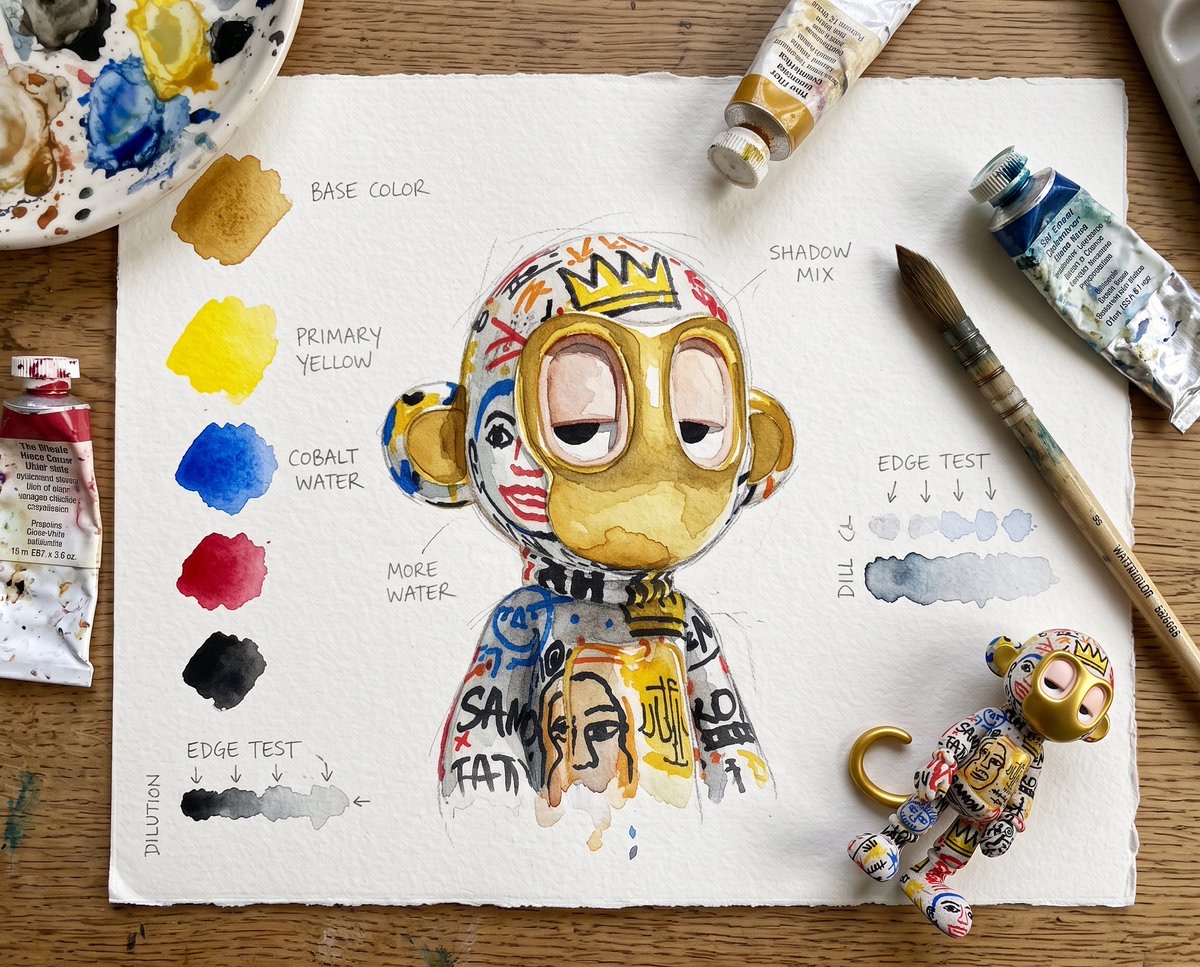
把上传角色转化为带有颜料水痕、色彩测试、手写笔记与实体画具的俯拍水彩研究页。
 Edizkan ⭕🦇@edizkan_
Prompt
Create an authentic watercolor artist’s study sheet of the uploaded reference character, photographed from directly above on a real working desk.
Likeness Integrity

Preserve the character’s exact identity: proportions, head shape, eye shape and spacing, facial structure, silhouette, clothing, accessories, materials, and original color relationships. Do not humanize or redesign the character. Translate the character into watercolor while keeping it instantly recognizable.
Main Painting

At the center of a large sheet of thick, slightly textured watercolor paper is a loose hand-painted portrait of the character, primarily showing the head, shoulders, and upper torso.
The watercolor should feel genuinely handmade and exploratory:
transparent layered washes
visible pigment blooms and water edges
areas where paint bleeds naturally into neighboring colors
dry-brush marks
occasional exposed white paper
subtle pencil construction lines still visible underneath
some sections carefully resolved while others remain unfinished
irregular edges rather than a digitally perfect silhouette
Preserve the character’s original palette, translating each color into believable watercolor pigment mixtures rather than replacing it with a generic watercolor palette.
Artist Study Elements

Surround the portrait with small experimental paint swatches derived from the character’s exact colors. Add handwritten artist notes, arrows, circles, mixture tests, dilution experiments, and tiny color studies around the page.
The notes should feel spontaneous and functional, discussing ideas such as:
“BASE COLOR”
“SHADOW MIX”
“MORE WATER”
“LESS PIGMENT”
“SECOND WASH”
“EDGE TEST”
Keep the writing sparse and imperfect, like genuine pencil notes made during painting rather than graphic-design typography.
Place several real watercolor paint tubes matching the character’s palette directly on top of the paper, with subtle dents and traces of dried paint around their caps. Include one well-used watercolor brush lying diagonally across the sheet, its bristles stained with one of the character’s dominant colors.
A few accidental paint droplets, faint water stains, test strokes, and pigment marks should appear naturally around the study.
Camera & Composition

Top-down documentary photography, approximately 35–50mm equivalent. The paper fills most of the frame but is slightly rotated rather than perfectly aligned. Crop a few art materials naturally at the frame edges.
The central portrait sits slightly off-center, with color experiments and physical tools creating an asymmetrical working composition.
Lighting & Texture

Soft directional daylight from one side, revealing the tooth of the watercolor paper, raised paint deposits, metallic paint tubes, brush hairs, pencil graphite, and subtle shadows cast by the physical objects.
Primary focal plane on the painted face and nearby brush. Paper edges and peripheral tools gradually soften slightly.
Mini Toy Reference, Bonus Element
Include a small collectible toy version of the uploaded character lying casually on the watercolor paper near one lower corner of the composition.

The miniature must preserve the character’s exact proportions, eye shape, silhouette, colors, materials, clothing, and accessories. It should look like a premium physical figurine of the same character, not a redesigned chibi version.

Pose it naturally on its back or slightly rolled onto one side, as if the artist placed it down while working. One limb may rest loosely across the paper, creating a subtle overlap with nearby color swatches or handwritten notes.

Keep the toy secondary in scale, approximately 10–15% of the composition, small enough that the watercolor portrait remains dominant.

Soft directional daylight should cast a believable miniature shadow beneath the toy. The closest parts of the figurine can be moderately sharp, while portions farther from the main focal plane soften slightly with the shallow depth of field.
The result should feel like a real photograph of an artist developing the character’s color language by hand, intimate, tactile, imperfect, and still visibly in progress. No clean digital illustration, no perfectly filled shapes, no polished poster layout, no sterile studio presentation.
ar 5:4
使用建议
上传角色参考图后保留其配色和造型,再调整周围颜料测试与画具细节。
信息
- 类型
- 文本
- 许可
- Source-author-rights
- 发布时间