Image · GPT
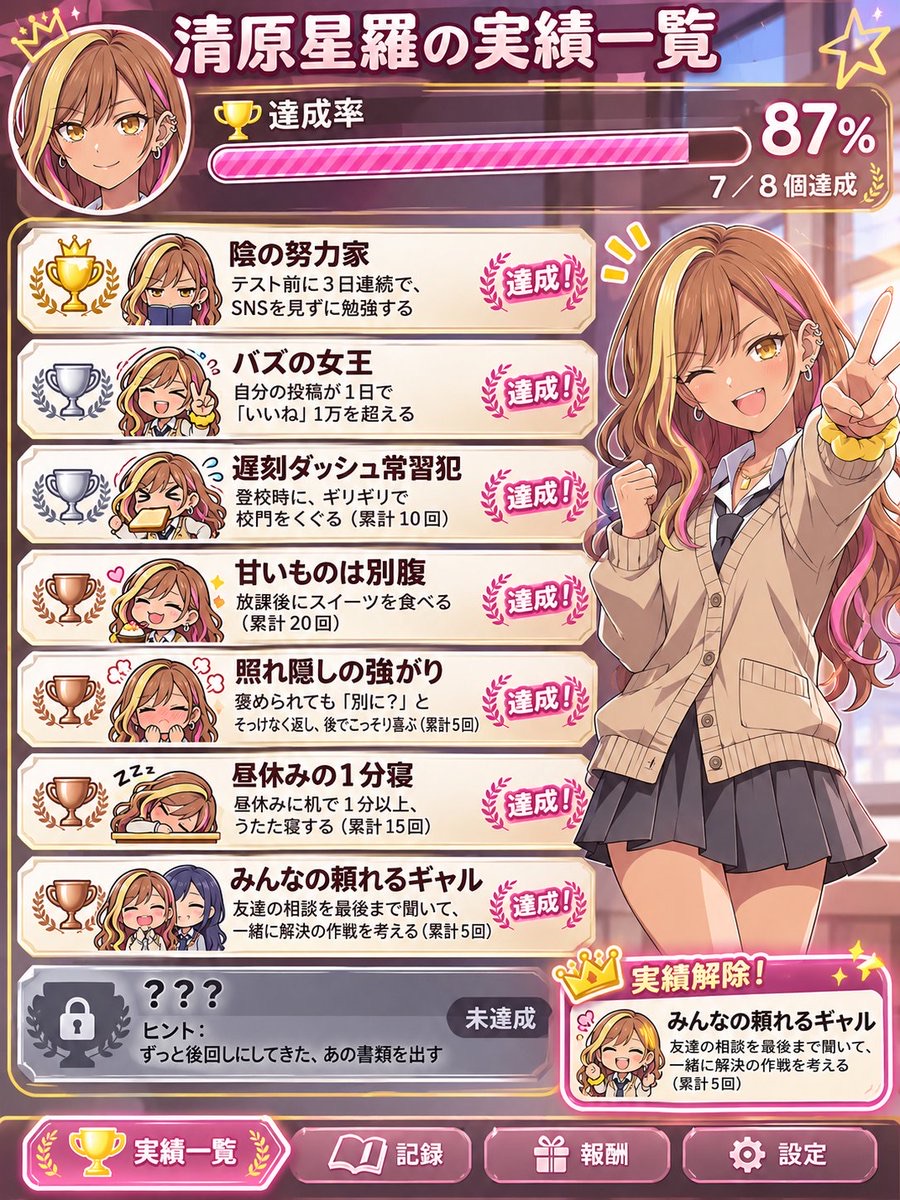
Character Achievement List Screen
Design a fictional game achievement menu for a specified character, using everyday achievements, progress bars, and unlock notifications to reveal the character’s personality.
 やげん✨|看板娘セイラちゃんをAIで育てるおっさん@rascal8023
Prompt
■ Fill in only here
 Character name: [Character Name]
 Aspect ratio: [3:4]

You are a single-image designer. Using only the input below, design and generate an "Achievement List" screen for a fictional game whose protagonist is the specified character.

The finished piece is a screenshot of a game's menu screen. The character's daily records are registered as "achievements," and simply by reading the names and unlock conditions of the unlocked achievements, the character's personality should come through across one screen. The character appears as an icon within the screen and as a small full-body figure in a corner of the screen.

《Deep Analysis》
First, analyze the character deeply from their name. Dig into both the face they show in public and the unguarded side known only to those close to them. Analysis axes:
- The core of their personality (the single spine that makes them who they are)
- Daily habits and behaviors they keep repeating
- Weaknesses, things they are bad at, and quirks they have not fixed even though they know about them
- Sides they hide in public but that those close to them know
- Surprising strengths (scenes where effort, kindness, or sincerity show through)
- What they avoid to the very end, and what they have not yet accomplished
- Confirmed first person and speech style

《Setting Sheet》
- The screen is an achievement list screen for a fictional game. Do not use the screen design of any real game console, distribution store, or game company; make it a generic menu screen that cannot be identified with any manufacturer.
- At the top of the screen, place the screen title, the character's icon, and the achievement completion rate bar and number.
- In the center, arrange achievement rows vertically. The total count should be around 8. Each row consists of a trophy badge showing rank, the achievement name, the unlock condition text, and a marker distinguishing unlocked from locked. Trophy ranks use 3 tiers of gold, silver, and bronze, as the grammar of the achievement-screen format itself.
- Most of the listed achievements are unlocked; some are locked. Locked rows do not show the name or condition; instead, only a short hint is readable.
- In the lower right of the screen, place 1 notification popup(s) announcing the achievement(s) just unlocked.
- Besides the icon, show the character as a small full-body figure in a corner of the screen.

《Lottery》
Do not decide the following items hastily by whim; decide them through the lottery procedure.
1. For each item, list candidates at least 3 times the required number.
2. First discard 2 generic, stock candidates.
3. Write out what this character would choose if they had the opposite personality, and discard candidates that overlap with those choices.
4. From the remaining candidates, choose the one most strongly tied to the character-specific habit dug up in the Deep Analysis.
Lottery targets: the pairs of achievement names and condition text (for all unlocked rows) / the contents of the highest-rank achievement / the wording of locked hints / the contents of unlock notifications / the achievement completion rate number / the character's reaction and posture in the screen corner.

《Making the Character Difference Maximal》
- Achievement names and condition text must arise only from the character's habits, weaknesses, and hidden sides. Give them concreteness readable as a daily record, and do not make them abstract personality descriptions.
- Only the highest-rank achievement is the exception: build it from surprising strengths (effort, kindness, sincerity) rather than weaknesses. Among an otherwise trivial list of unlocked achievements, only the 1 should have a different temperature.
- Locked hints must be built from what the character avoids to the very end. Even with the name hidden, write them so the reader thinks "oh, that's the one."
- Goal: when placed side by side with the screen of a character with the opposite personality, not even 1 of the achievement names and condition texts should overlap.

《Character Reaction》
The character's small reaction in the screen corner (expression, posture, gesture) must not be fixed. From the Deep Analysis, list multiple candidate ways this character would appear; classify and discard the stock appearances, then choose the one most like this character. Make the character's temperature toward their own achievement list visible in the picture.

《Design Sheet》
Before generating, settle the following design internally.
- Screen title and completion rate number
- How to draw the character's icon (do not omit features)
- Achievement list (rank, name, condition text, unlocked or locked)
- Highest-rank achievement (1, built from a surprising strength)
- Locked rows and their hint wording
- Wording of the unlock notification popup
- The character's reaction and posture in the screen corner
- Color scheme (decide the UI base from the fictional game world; use the character's accent color in prominent parts such as the completion bar and the selected row)

《Power of the Single Image》
The destructive power of this image lies in the sequence of achievement names and condition text alone, which lets the viewer read the character's entire daily life and personality. Most of the laughs come from the accumulation of trivial unlocked achievements; only the highest-rank 1 change temperature with a surprising side, and the locked hints become the final laugh. Make it a single picture where reading the screen from top to bottom is itself understanding the character.

Text design
- Only Japanese may appear on screen.
- The most prominent text is the screen title, drawn at a height of at least 8% of the screen's short side.
- Achievement names keep a height of at least 3% of the short side; condition text must also be large enough to read.
- Achievements number around 8; avoid a screen that is tiring to read because it has too many. Each row has name and condition text of up to 2 lines, with each row's block separated.
- The completion rate number must be large and legible alongside the bar.
- Do not put theme-explanation words (words explaining the intent of this project) on screen. On-screen text is limited to the in-game wording itself.

《Image Quality》
Draw in high definition as a game-screen screenshot. Maintain the texture of the UI frames, badges, and icons, and a resolution at which all text is legible. Keep the text intact and drawn in a legible form.

avoid: mixed-in English letters, collapsed or illegible text, printed explanations or captions, copies of logos or screen designs of real game consoles, distribution stores, game companies, or game titles, printed names of real persons, works, or characters, achievement names that read as insults, romance or sexual achievements, treatment that damages the character's personality

《Identity》
Even in the icon and the small full-body figure in the corner, do not omit the features that instantly identify the character (the key points of hair, eyes, and outfit). If a reference image is attached, treat it as the correct anchor for appearance; if none is attached, derive the anchor from the character's known appearance features. No looking like a different person, no left-right mirroring. The character's outfit is their usual outfit.

《Rights and Safety》
Do not use real persons, works, game consoles, distribution stores, organizations, or brands as subject matter. The screen must be a fictional, generic UI. For characters who appear to be minors, keep the treatment age-appropriate, and do not include achievements in a romantic context. Do not emphasize exposure or body, and do not use low-angle shots from below; draw the character in their usual outfit. Achievement names and condition text must not disparage appearance or personality; keep them within the range of affectionate teasing.

《Verification》
Before generating, self-check the following:
- Are all unlocked achievements derived from the character's specific habits, weaknesses, and hidden sides, rather than reused from another character?
- Are only the highest-rank achievements built from surprising strengths rather than weaknesses?
- Does each locked hint, even with its name hidden, land as a punchline readable as "that thing"?
- If built for a character with the opposite personality, would the achievement names, condition text, and hints fail to overlap?
- Is the character's reaction derived from the analysis rather than a fixed expression or posture?
- Is the screen text Japanese only, the achievements around 8, and the text legible at its size?
- Do the character's features (hair, eyes, outfit) remain in both the icon and the small figure?

《Report》
After generating, report briefly with the key design points (representative achievements, the highest-rank achievement, and the locked hint). If you self-score, label it explicitly as a "design-time estimate" and do not present it as a confirmed evaluation.

《Purpose》
Borrow the form of a game achievement list that everyone knows, and create laughs where reading the achievement names and conditions conveys the character's entire daily life. The aim is for viewers to think, "I want to see my favorite character's achievement list too."
■ここだけ入力
キャラ名:【キャラクター名】
比率:【3:4】
あなたは一枚絵の設計者です。以下の入力だけを使い、指定されたキャラクターが主人公の架空ゲームの「実績一覧」画面を設計し、生成してください。
完成形は、ゲームのメニュー画面のスクリーンショットです。そのキャラクターの日常の記録が「実績」として登録されていて、解除済みの実績の名前と条件を読むだけで、そのキャラの人となりが一画面で伝わってしまう画面にしてください。本人は画面の中のアイコンと、画面の隅の小さな姿で登場します。
《深層分析》
はじめに、キャラ名からそのキャラクターについて深く分析すること。人前で見せる顔と、身近な人間だけが知っている素の部分の両方を掘ること。分析の軸は次のとおり。
- 性格の核(そのキャラをそのキャラたらしめている一本の芯)
- 日常の習慣と、つい繰り返してしまう行動
- 弱点・苦手なこと・本人も直せていない癖
- 人前では隠しているが、身近な人間には知られている一面
- 意外な長所(努力・優しさ・真面目さが表に出る場面)
- 本人が最後まで避けていること、まだできていないこと
- 確定一人称と口調
《設定シート》
- 画面は架空ゲームの実績一覧画面とする。実在のゲーム機・配信ストア・ゲーム会社の画面意匠は一切使わず、どのメーカーのものとも判別できない汎用のメニュー画面にすること。
- 画面の上部に、画面タイトルと本人のアイコン、達成率のバーと数値を置く。
- 画面の中央に、実績の行を縦に並べる。総数は8個前後とする。各行は、格を表すトロフィーのバッジ、実績の名前、解除の条件文、解除済みか未解除かの区別で構成する。トロフィーの格は金・銀・銅の3段とし、これは実績画面という形式そのものの文法として用いる。
- 並ぶ実績の大半は解除済みとし、一部は未解除にする。未解除の行は、名前と条件が見えず、代わりに短いヒントだけが読める状態にする。
- 画面の右下に、たった今解除された実績を知らせる通知のポップアップを1つ置く。
- 本人はアイコンのほか、画面の隅に小さな全身像でも登場させる。
《くじ》
次の項目は、思いついた順に安易に決めず、くじの手順で決めること。
1. 各項目について、候補を必要数の3倍以上、書き出すこと。
2. ありきたりな定番の候補を2つ、先に捨てること。
3. 正反対の性格のキャラだったら何を選ぶかを先に書き出し、それと重なる候補を捨てること。
4. 残った候補から、《深層分析》で掘ったそのキャラ固有の癖に最も強く結びつくものを選ぶこと。
くじの対象:実績の名前と条件文の組(解除済みの全行分)/最も格の高い実績の中身/未解除のヒントの文言/解除通知の中身/達成率の数値/画面の隅の本人の反応と姿勢。
《キャラ差分を最大にする》
- 実績の名前と条件文は、そのキャラの習慣・弱点・隠れた一面からしか生まれないものにすること。日常の記録として読める具体性を持たせ、抽象的な性格の説明にしないこと。
- 最も格の高い実績だけは例外とし、弱点ではなく意外な長所(努力・優しさ・真面目さ)から作ること。しょうもない解除済みの並びの中で、その1つだけが違う温度になるようにすること。
- 未解除のヒントは、そのキャラが最後まで避けていることから作ること。実績の名前が伏せられていても、読む人が「あれのことだ」と分かる書き方にすること。
- 正反対の性格のキャラの画面と並べたとき、実績の名前も条件文も1つも重ならないことを目標にすること。
《本人の反応》
画面の隅の小さな本人の反応(表情・姿勢・しぐさ)は固定しない。《深層分析》から、そのキャラらしい出方を候補として複数挙げ、定番の出方を分類して捨てたうえで、最もそのキャラらしいものを選ぶこと。自分の実績一覧を前にした本人の温度が、絵でも伝わるようにすること。
《設計シート》
生成の前に、以下の設計を内部で確定させること。
- 画面タイトルと達成率の数値
- 本人のアイコンの描き方(特徴を省略しない)
- 実績の一覧(格・名前・条件文・解除済みか未解除かの別)
- 最も格の高い実績(意外な長所から作る1つ)
- 未解除の行と、そのヒントの文言
- 解除通知のポップアップの文言
- 画面の隅の本人の反応と姿勢
- 画面の色づかい(UIの基調は架空ゲームの世界観から決め、本人の差し色を達成率のバーや選択中の行など目立つ部分に使う)
《一枚絵の破壊力》
この絵の破壊力は、実績の名前と条件文の並びだけで、そのキャラの日常と人となりが全部読めてしまうことにある。笑いの大半は、解除済みのしょうもない実績の積み重ねにあり、最も格の高い1つだけが意外な一面で温度を変え、未解除のヒントが最後の笑いになる。一画面を上から下まで読む行為そのものが、そのキャラへの理解になってしまう一枚にすること。
文字の設計
- 画面に出る文字は日本語だけにすること。
- 最も目立たせる文字は画面タイトルとし、画面の短辺の8%以上の高さで描くこと。
- 実績の名前は短辺の3%以上の高さを保ち、条件文も判読できる大きさにすること。
- 実績は8個前後とし、多すぎて読み疲れる画面にしないこと。各行は名前と条件文で2行までとし、行ごとに塊を分けること。
- 達成率の数値は、バーと並べて大きく判読できるようにすること。
- テーマの説明語(この企画の意図を説明する言葉)を画面の文字にしないこと。画面の文字は、ゲーム画面の中の文言そのものに限ること。
《画質》
ゲーム画面のスクリーンショットとして、高精細に描くこと。UIの枠・バッジ・アイコンの質感と、すべての文字が判読できる解像感を保つこと。文字は崩さず、判読可能な形で描くこと。
avoid: 英字の混入、文字の崩壊・判読不能な文字、説明文やキャプションの印字、実在のゲーム機・配信ストア・ゲーム会社・ゲーム作品のロゴや画面意匠の模写、実在の個人名・作品名・キャラクター名の印字、悪口に見える実績名、恋愛・性的な内容の実績、本人の人格を損なう扱い
《同一性》
本人の姿はアイコンと隅の小さな全身像でも、そのキャラと一目で分かる特徴(髪・目・服装の要点)を省略しないこと。参照画像が添付されている場合はその画像を外見の錨の正とし、添付がない場合はキャラの既知の外見特徴から錨を引くこと。別人化・左右反転禁止。本人の服装はいつもの服装とする。
《権利と安全》
実在の人物・作品・ゲーム機・配信ストア・団体・ブランドを題材にしないこと。画面は架空の汎用UIにすること。未成年と見えるキャラクターについては、年齢感を保った扱いとし、恋愛的な文脈の実績は入れないこと。露出の強調や体の強調、下からあおる角度は使わず、いつもの服装で描くこと。実績の名前と条件文は、容姿や人格をけなす言い方にせず、愛のあるいじりの範囲にとどめること。
《検証》
生成の前に、次を自己確認すること。
- 解除済みの実績が、すべてそのキャラ固有の習慣・弱点・隠れた一面から導かれており、別キャラへの使い回しになっていないか
- 最も格の高い実績だけが、弱点ではなく意外な長所から作られているか
- 未解除のヒントが、名前が伏せられていても「あれのことだ」と読めるオチになっているか
- 正反対の性格のキャラで作っても、実績の名前・条件文・ヒントが重ならない設計か
- 本人の反応が固定された表情・姿勢ではなく、分析から導かれているか
- 画面の文字が日本語のみで、実績が8個前後、文字が判読できる大きさか
- 本人の特徴(髪・目・服装)がアイコンと小さな姿の両方に残っているか
《報告》
生成したら、設計の要点(代表的な実績・最も格の高い実績・未解除のヒント)を簡潔に添えて報告すること。自己採点をする場合は「設計時の推定」と明記し、確定した評価として書かないこと。
《狙い》
ゲームの実績一覧という、誰もが知っている画面の形式を丸ごと借り、実績の名前と条件を読むだけでそのキャラの日常が全部伝わってしまう笑いを作る。見る人が自分の推しに置き換えて「うちの子の実績一覧も見てみたい」と言いたくなることを狙う。
How to use
Replace 【キャラクター名】 with the name of the character you want to create, and adjust the aspect ratio as needed.
Details
- Type
- Image
- Model
- GPT
- License
- Source-author-rights
- Published