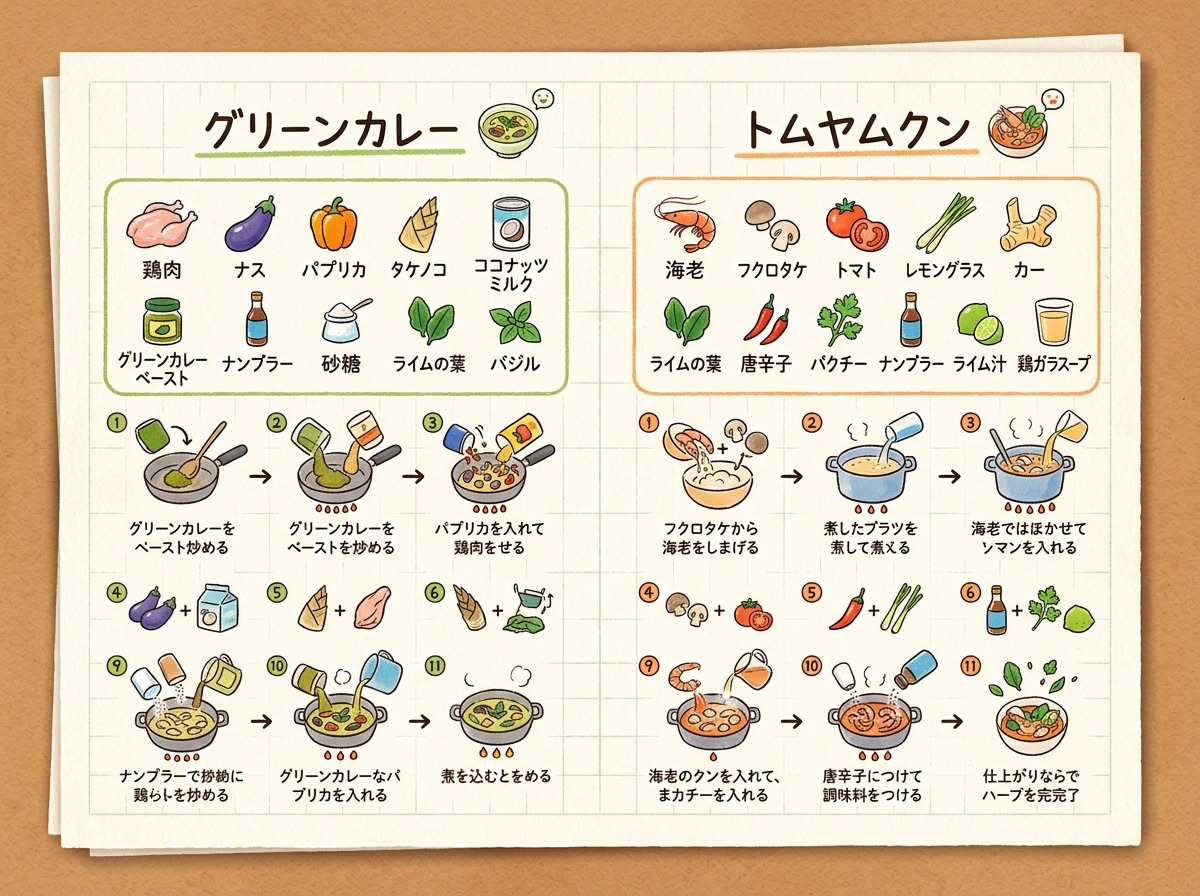
Image · Nano Banana Pro
Turn your signature dish into a handwritten recipe page
Arrange ingredients and steps in two columns, leaving a cooking note you can share.
 AI Guide-Note - 実務で使えるAI活用メディア@AIGuideNote
Prompt
[Input data]
- Dish name (left page): Green curry
- Ingredient list (left page): {ingredientsLeft}
- Cooking steps (left page): ①{stepLeft1} → ②{stepLeft2} → ③{stepLeft3}
- Dish name (right page): Tom yum soup
- Ingredient list (right page): {ingredientsRight}
- Cooking steps (right page): ①{stepRight1} → ②{stepRight2} → ③{stepRight3}
- Color theme: organic natural colors

[结构与布局规范]
- Style: A flat 2D handwritten-style infographic recipe illustration drawn on a rustic off-white sticky note (graph paper), with fine grid lines and warm paper texture.
- Background and composition restrictions: Absolutely do not draw a physical book, a three-dimensional notebook outline, page thickness, shadows, or realistic photographic background elements such as a wooden table (absolutely no wooden table, no realistic book model, no book thickness, no notebook pages, and no realistic photographic background. It must be a flat 2D vector layout directly on a textured graph-paper sticky-note canvas).
- Left-side layout:
  - Place the prominent handwritten Japanese title “{dishLeft}” at the top.
  - Below it, present the ingredient list “{ingredientsLeft}” as neat vertical bullet points, accompanied by handwritten Japanese and simple food illustrations.
  - The lower half contains the cooking steps “①{stepLeft1} → ②{stepLeft2} → ③{stepLeft3}”, arranged as a horizontal or vertical arrow flow. Include cute hand-drawn illustrations matching the content of each step (for example: chopping vegetables, stir-frying, simmering).
  - Add a very appetizing-looking illustration of the finished “{dishLeft}” dish in the lower-left corner.
- Right-side layout:
  - Place the prominent handwritten Japanese title “{dishRight}” at the top.
  - Below it, present the ingredient list “{ingredientsRight}” in handwritten Japanese, accompanied by simple food illustrations.
  - The lower half contains the cooking steps “①{stepRight1} → ②{stepRight2} → ③{stepRight3}”, arranged as a horizontal or vertical arrow flow. Include cute hand-drawn illustrations matching the content of each step.
  - Add a very appetizing-looking illustration of the finished “{dishRight}” dish in the lower-right corner.
- Colors: soft, warm organic colors based on “{colorTheme}”.

[质量与排除限制(强制性)]
- Absolutely prohibit any date-related elements, such as dates (for example: “8/7”), days of the week (for example: “SUN”), calendar boxes, or date stamps (no date stamps, no calendars, no days of the week, and no timeline stamps).
- The font should be friendly handwritten-style Japanese (Gothic or rounded), accurately render the input Japanese, and contain no distortions or spelling errors.

- Aspect ratio: --ar 4:3
[输入数据]
- 菜名(左页):绿咖喱
- 食材清单(左页):{ingredientsLeft}
- 烹饪步骤(左页):①{stepLeft1} → ②{stepLeft2} → ③{stepLeft3}
- 菜名(右页):冬阴功汤
- 食材清单(右页):{ingredientsRight}
- 烹饪步骤(右页):①{stepRight1} → ②{stepRight2} → ③{stepRight3}
- 色调主题:有机自然色
[结构与布局规范]
- 风格:绘制在质朴的米白色便签纸(网格纸)上的扁平化 2D 手写风格信息图食谱插画,带有细网格线和温暖的纸张纹理。
- 背景与构图限制:严禁绘制实体书、三维笔记本轮廓、页面厚度、阴影或木桌等写实照片背景元素(绝对禁止木桌、禁止写实书本模型、禁止书本厚度、禁止笔记本页面、禁止写实照片背景。必须是直接在带纹理的网格便签纸画布上的扁平化 2D 矢量布局)。
- 左侧布局:
- 顶部为醒目的手写日文标题“{dishLeft}”。
- 下方为食材清单“{ingredientsLeft}”,以整齐的垂直项目符号呈现,配有手写日文和简单的食物插图。
- 下半部分为烹饪步骤“①{stepLeft1} → ②{stepLeft2} → ③{stepLeft3}”,按水平或垂直箭头流程排列。包含与每一步内容相符的可爱手绘插图(例如:切菜、翻炒、炖煮)。
- 左下角配有一幅看起来非常美味的“{dishLeft}”成品插图。
- 右侧布局:
- 顶部为醒目的手写日文标题“{dishRight}”。
- 下方为食材清单“{ingredientsRight}”,以手写日文呈现,配有简单的食物插图。
- 下半部分为烹饪步骤“①{stepRight1} → ②{stepRight2} → ③{stepRight3}”,按水平或垂直箭头流程排列。包含与每一步内容相符的可爱手绘插图。
- 右下角配有一幅看起来非常美味的“{dishRight}”成品插图。
- 颜色:基于“{colorTheme}”的柔和、温暖的有机色调。
[质量与排除限制(强制性)]
- 绝对禁止任何与日期相关的元素,如日期(例如:“8/7”)、星期(例如:“SUN”)、日历框或日期戳(禁止日期戳、禁止日历、禁止星期、禁止时间轴戳)。
- 字体应为友好的手写风格日文(黑体或圆体),准确绘制输入的日文,不得变形或出现拼写错误。
- 长宽比:--ar 4:3
How to use
The default dish names are green curry and tom yum soup. When editing, fill in ingredientsLeft/Right, stepLeft1–3, and stepRight1–3, and replace every dishLeft, dishRight, and colorTheme with consistent dish names and color tones. The original text calls for Japanese text; change this requirement when using Chinese instead. The preview includes notebook edges and a tabletop feel, so it does not fully follow the original flat-layout restriction; the text in the image, quantities, and cooking times still need checking.
Details
- Type
- Image
- Model
- Nano Banana Pro
- License
- CC-BY-4.0