Image · Kling 3
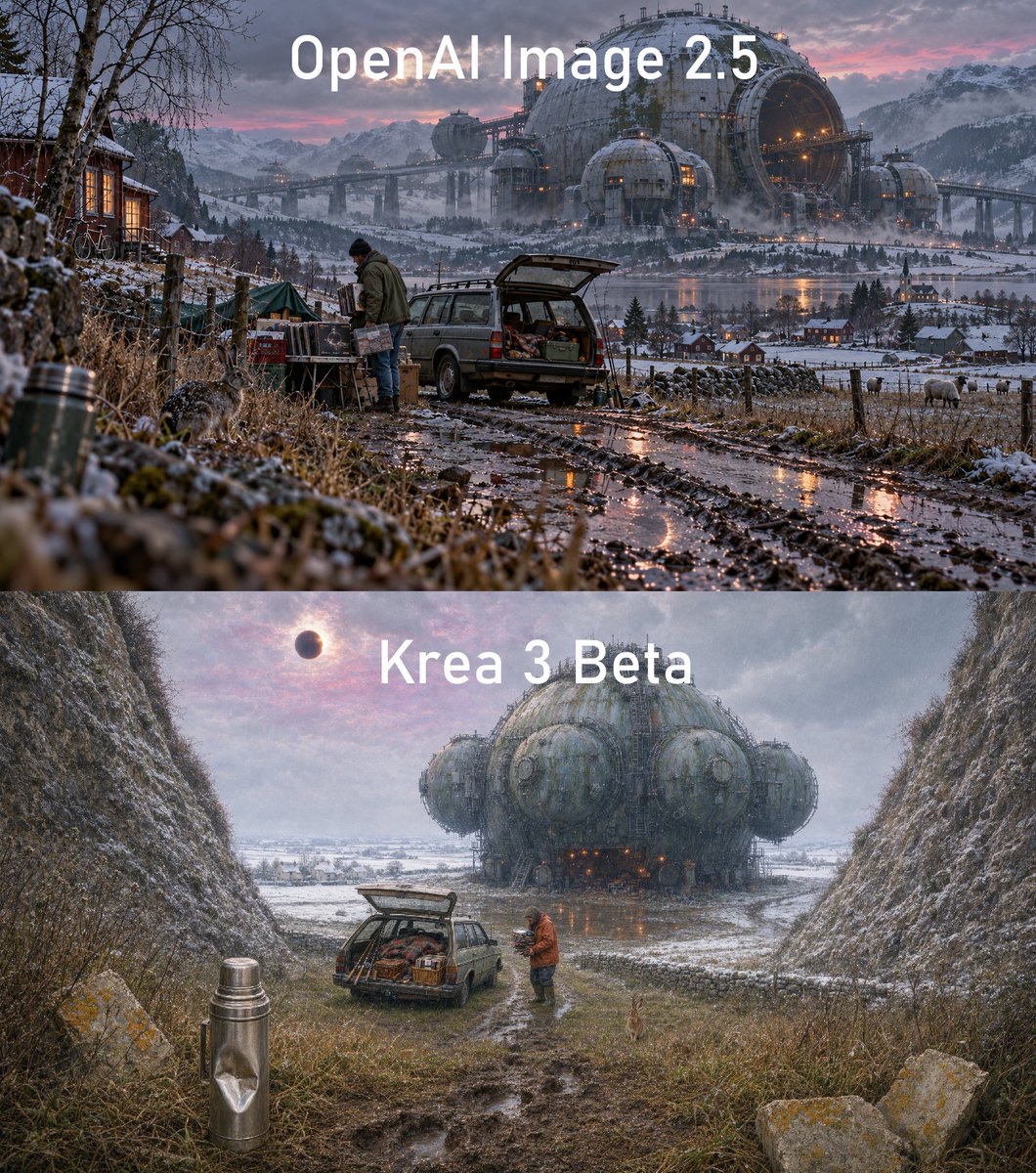
Winter Old-World Sci-Fi Landscape
Juxtapose rural daily life in rain and snow with a weathered, giant nuclear reactor, using restrained light and color to create a nostalgic and mysterious atmosphere.
 David Hendrickson@TeksEdge
Prompt
Generate an emotionally resonant wide landscape that feels remembered rather than staged. The setting is a brush-filled canyon mouth opening into farmland, during midwinter overcast with thick powder on roofs and fields at moonlit eclipse. flea-market vendor sorting vinyl records is carrying a stack of floppy-disk cases through the rain, with a hare frozen in the grass near the path sharing the scene. Farther back, a hulking spherical reactor dome ringed with auxiliary pods extends across the distance with layers of ladders, hatches, gantries, and maintenance doors. Terrain character: muddy grazing land with wheel ruts and low stone walls. Terrain micro-detail: lichen-scabbed concrete fragments, dry grass, and mouse paths through weeds. Emotional landscape: make the beauty come from pale northern light, wet ground, distance, and the feeling of time passing. Human feeling: let the figures seem absorbed in an ordinary task rather than reacting dramatically to the technology. Ordinary-life detail: an old blanket and fishing tackle are piled in the back of a station wagon. Foreground micro-detail: muddy footprints, flattened grass, and a dented thermos near the camera. Sky: streaks of pink and violet afterglow. Material detail: wet galvanized metal, cracked rubber seals, algae, and mineral deposits. Futuristic light accent: several tiny amber maintenance lamps glowing deep inside an otherwise dark machine cavity. Atmosphere: subdued wonder, glimmering ice crystals in still air. Color palette: dusty teals and muted oranges. Composition: low eye-level composition with the human figure small against the machinery. Photographic framing cues for the painting: 16 × 9 wide cinematic frame, 20 mm ultra-wide lens, foreground slightly soft while the distant machinery remains sharply resolved, 1/320 s, f/3.5, ISO 500; after-rain reflections multiplying small points of machine light; naturalistic digital paint with hints of dry-brush texture and careful atmospheric blending; a faint moisture glow around distant lamps. Scale: use familiar cars, trees, bicycles, animals, fences, and houses as scale references. The scene should suggest a world where impossible technology faded quietly into routine life. Do not default to water-and-mountain scenery unless those elements were selected. Use pale weather, long distances, ordinary late-1980s/early-1990s clothing and objects, children and adults who feel candid rather than posed, believable animals, and monumental impossible technology that has become old, familiar, weathered, and partly reclaimed by nature. The technology can be huge, eerie, robotic, elegant, or derelict, but do not make every image feel like an industrial worksite. Let friendship, family, play, animals, solitude, weather, home, and landscape carry the emotional weight. Use restrained cyan, amber, red, or blue-white futuristic glows as accents, not neon spectacle. Avoid glossy cyberpunk, heroic sci-fi posing, grimdark warfare, and generic factory concept art. The image should feel mysterious, tender, beautiful, and slightly unsettling without explaining the world.
How to use
Suitable for concept art that emphasizes environmental storytelling; weather, technological ruins, and character activity can be adjusted.
Details
- Type
- Image
- Model
- Kling 3
- Source
- David Hendrickson
- License
- © the author
- Published